
Hetts are able to deal with the entire lease extension process from start to finish for both leaseholders and freeholders, including arranging the valuation, serving notices, negotiating the lowest possible premium, drafting the paperwork and application to the Land Registry post-completion. Our solicitor, Ashley Connell is a widely recognised industry expert.
IF YOU ARE A LEASEHOLDER – WE ARE CURRENTLY ONLY TAKING ON LEASE EXTENSIONS WHERE THE FREEHOLDER IS A LOCAL AUTHORITY / COUNCIL
This is to manage our workload, to ensure we provide a quick and efficient service to our clients, due to a high demand for our services.

Jump to the right section
I am a leaseholder
I am a landlord / freeholder
Lease Extension Solicitors for Leaseholders
Specialists with most local authorities: Islington, Tower Hamlets, Barnet, Bromley, Crawley, Ealing, Hackney, Harrow, Hounslow, Lambeth, Kensington & Chelsea, Lewsham, Waltham Forest, Wandsworth, Southwark, Sutton, Luton, Bath etc.
Legal fees – Formal Statutory Route
Full package including Valuation, Legal Fees and Negotiation: £1,750 + VAT (and disbursements of approximately £80)
What this fee includes:
- Comprehensive Valuation with detailed calculations
- Section 42 notice preparation and service
- Negotiation by an experienced professional, with 20 years of experience
- All legal work
- Dealing with your mortgage lender, if required
- Land Registry application
- Direct contact with Ashley Connell, a highly regarded expert in lease extensions
Valuation of the lease extension price
The premium that you should expect to pay is based upon a complex algorithm in accordance with statute law. The algorithm is constantly changing due to modifications set out in recent cases at the Court of Appeal. We arrange a professional valuation providing a comprehensive breakdown of the estimated calculated premium. The valuation is carried out remotely; access is not required as the calculation involves variables contained within your lease as well as comparable market evidence in your local area.
The valuation report you receive is very comprehensive.
Negotiation of the premium
We have substantial experience in negotiating premiums and in cases where the freeholder is insisting on a higher premium, we are usually always successful in reducing this.
Time scales from instructions
Within 2-4 working days – a full valuation report is provided
Following the valuation, the section 42 notice can be served within 2-4 working days commencing the lease extension process.
Group Discounts
If more than one leaseholder instructs us, at the same time, our fees can be discounted. Please contact us for a bespoke quote.
Payment Timeline
An initial payment is required in the sum of £350 to commence matters. A file will be opened and we will begin the lease extension valuation and investigation of the Land Registry title and Lease.
Upon service of the Section 42 notice, a further payment of £350 is required. The remainder of our fees are paid when completing the lease extension, which tends to be around 4 months after the service of the Section 42 notice.
Legal fees – If the premium has been agreed
This is call the ‘informal route’, as opposed to the ‘statutory route’, above. The informal route is less common, and can lead to paying a higher premium to the freeholder in some cases. Fixed total fees of £1,200 + VAT and disbursements of approximately £80 (including Land Registry fees to register the lease extension, dealing with your mortgage lender, ID check and bank transfer fees).
These fees assume that you have come to an agreement with your Landlord to extend the lease. If more than one Leaseholder instructs us simultaneously (under the same freehold title) there is scope for a reduction in our fees, see below (block lease extensions).
Contact Us

Want to extend your residential lease?
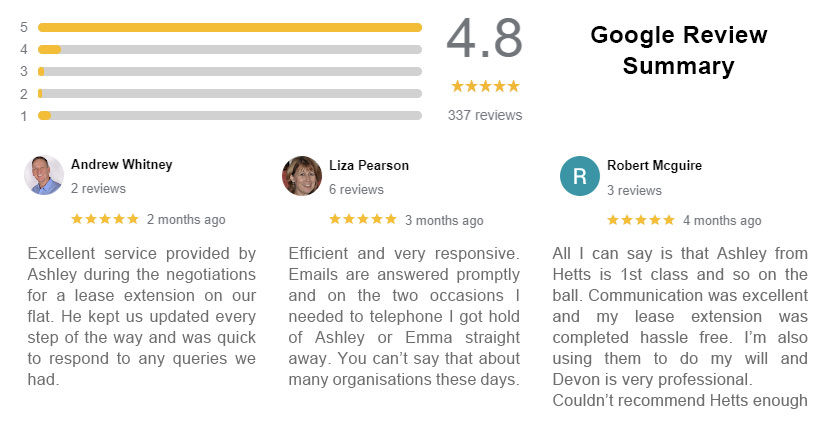
I'm based in London but instructed Hetts do deal with my lease extension... the process was fast and seamless and far less expensive than a local firm.

Clear price guarantee
Our fees fixed. There will be no further unknown / surprise costs that are not stated at the outset.

We act nationwide
Many of our clients are located across England and Wales due to our competitive fee structure. We particularly encourage clients in London to seek quotes from firms outside the city, such as with Hetts.
Do I have a right to extend my lease?
Unless you agree informally, it is essential that you have owned the leasehold for a period of at least 2 years to qualify.
How much will it cost to extend my lease?
The answer to this question depends mainly on the length of term the lease has left. The key point to consider here is the effect of having less than 80 years left to run on the lease. Contact us to arrange a professional desktop valuation to work out an accurate cost. A comprehensive report can be arranged at a cost of £190 and will be used to assist with negotiating a lower premium with the landlord.
I have 80 or more years left to run on my lease - In this case you will only have to pay the Landlords premium (including his/her reasonable legal fees). This can either be agreed by both the Landlord and the Tenant coming to an agreement or otherwise through the First Tier Tribunal (FTT). The FTT will take into account many factors into consideration when determining the 'price' which are outlined in further detail down this page.
I have less than 80 years left to run on my lease - In this case the cost of extending your lease will be significantly more than if you have 80 or more years to run. In determining the cost for the lease extension, 'marriage value' now becomes an additional factor; an expensive one at that.
'Marriage value' is explained in more detail in the next section below.
If you currently hold the leasehold interest in a residential property, it is important to understand the implications of your ever decreasing term length resulting in it becoming a 'wasted asset'. As the number of years left on a lease decreases, so does it's value, however getting a lease extension may not have to be expensive if you act early and instruct specialist lease extension solicitors. There are two primary factors to consider in regards to residential lease extensions where are addressed below.
If the 'price' of extending the lease cannot be agreed
If, after serving a notice on the freeholder, both the Landlord and Tenant cannot agree on the price of the lease extension then the Leasehold Valuation Tribunal will determine it in accordance with the rules set out in statute and recent case law. The aim is to compensate the freeholder for the loss of interest in the property. The tribunal will attempt to put a figure on the following:
The value of the freeholders interest, including payment of lost ground rent.
The marriage value.
The proportional split between the freeholder and any intermediate landlords costs.
The amount of any compensation.
A good estimate of the costs can be found using this lease extension calculator, but keep in mind that a professional determination should be prepared in a full report to assist with negotiations. Contact us should you require this.
For how long can I extend my lease?
A period of 90 years is available as per the Leasehold Reform Housing and Urban Development Act, 1993. This is additional to the existing years currently existing on the lease. For this term, no ground rent will be payable.
How can I extend my lease?
Whether you are a freeholder or leaseholder it is strongly advised that you consult a solicitor to deal with lease extensions. The process can vary depending on whether the tenant and landlord can agree on a premium. Also if there are less than 80 years to run on the lease the process can become very complex and it is important that you are able to get the 'right' price for the extension.
Lease Extension Solicitors for Landlords / Freeholders
You will not pay any fees if you are a freeholder. The leaseholder will be responsible for meeting our fees of £950 plus VAT. If we are instructed to deal with multiple lease extensions simultaneously our fees can be reduced.
Hetts can deal with all matters on your behalf, including arranging a valuation for the premium payable be the leaseholder, as well as negotiating to achieve the best possible premium.
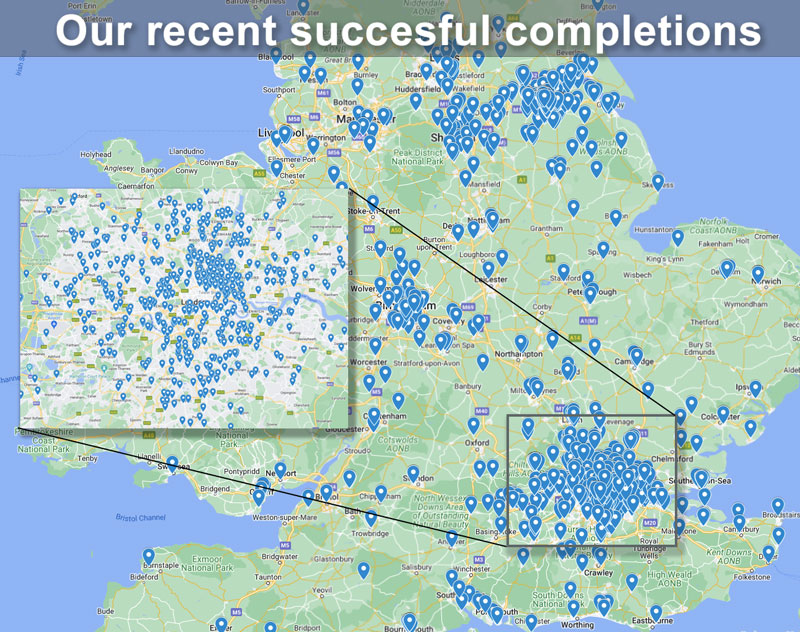
Where are our clients based?
Common areas we deal with:
Islington Lease Extensions
Tower Hamlets Lease Extensions
Hackney Lease Extensions
Hetts Solicitors have a huge range of experience with dealing with lease extensions in these areas.
Most of our clients are located in London, however we operate nationally. The map below visualises lease extensions that have recently completed with Hetts.
Why Hetts?
- Hetts are certified members of ALEP (The Association of Leasehold Enfranchisement Practitioners)
- Hetts have an astounding 29 years of experience in dealing with residential lease extensions.
- On average, our lease extensions take 3.75 weeks to complete, from the date that the premium is agreed.